
About
Genetics University
An institution for genome research, education and medical genetics — grounded in verifiable evidence and scientific honesty.

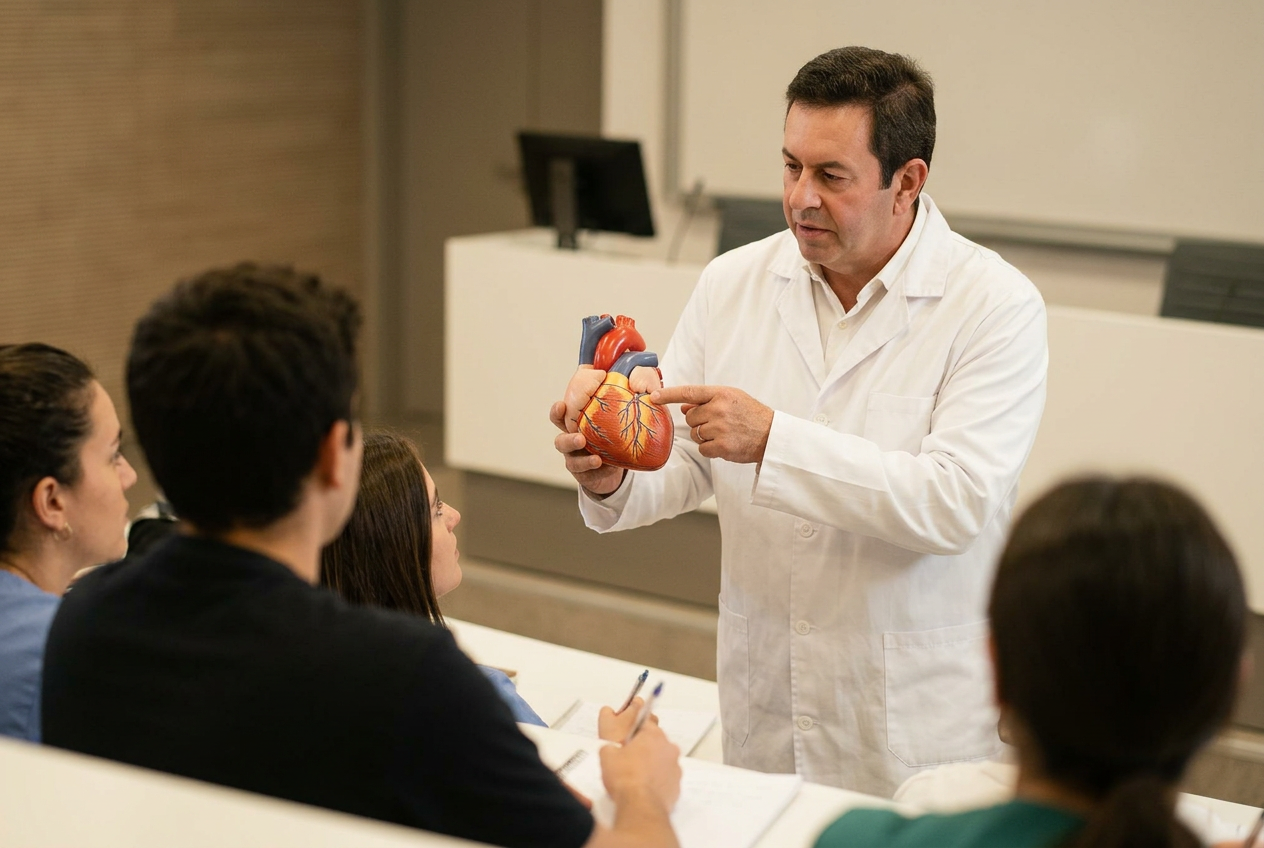

Our Vision
A future where every genome tells a story we can truly read.
“We are not merely sequencing letters — we are learning to listen to the language written into every human life, and to answer it with medicine that is precise, equitable and human.”
I founded Genetics University on a single conviction: that the genome is not a puzzle to be solved once, but a living text we must learn to read again and again — across populations, across decades, and with humility before what we do not yet know.
Our work stands at the meeting point of three commitments: rigorous science that names its uncertainty, education that builds judgment rather than memorisation, and translation that carries discovery to the bedside without exaggerating what it can promise.
I want this institution to be measured not by the volume of what it produces, but by its honesty, its patience, and its refusal to let hype outrun evidence. The next decade of genomic medicine will belong to those who can hold ambition and restraint in the same hand — that is the university I am building.
Prof. Roberto Grobman
Founder & President, Genetics University
Mission
Genetics University investigates the structure and function of the human genome, trains the next generation of geneticists, and supports the translation of genomic findings into clinical care.
Research, education and translation are treated as one continuous responsibility: what is taught must be supportable, and what is applied must be assessed.
Vision
A genomic medicine that is equally reliable across populations — supported by diverse reference data, transparent methods, and a public able to interpret genetic claims.
We measure success not by visibility but by the quality and reproducibility of what we publish.

Scientific integrity
The following principles apply to all content published on this website.
Verifiability
Every substantive claim on this site traces to a named, publicly accessible source. Claims without support are not published.
No invented credentials
The university publishes no invented people, degrees, metrics, rankings or partnerships. Positions are marked as unfilled until an appointment is confirmed.
Stated uncertainty
Where evidence is limited or contested, we say so. Probabilistic findings are never presented as diagnoses.
Correction over silence
Incorrect content is corrected, and the correction is made visible.
Locations
Headquartered in Wiesbaden, operating worldwide
Academic governance of Genetics University is based in Wiesbaden, Germany. Teaching, research coordination and institutional collaboration extend across ten further operating locations in Europe, the Americas and Asia-Pacific.
Headquarters
Wiesbaden, Germany
Headquarters. Academic governance, programme accreditation, research coordination and administration.
Europe
Americas
Asia-Pacific
Institutional collaboration
Teaching and mentorship inside your institution
Genetics University is built to work with other institutions rather than alongside them. Universities, academic medical centres and research institutes worldwide can establish specialised curricula in medical genetics and genome science together with us and offer them under their own academic roof.
Every collaboration begins with an assessment of need: which methods are actually in use, where the competence gaps sit, and which assessment and credit rules apply. From that we build a programme that fits the partner's curriculum rather than a finished package laid over it.
Established partnerships are published only once confirmed by both parties.
Programmes delivered on site
Specialised courses in genomics, epigenetics, multi-omics and proteomics are planned with the host institution and taught in its lecture halls, laboratories and clinics.
Executive training
Compact formats for clinical directors, laboratory leads and research groups, scoped to the diagnostic and scientific priorities of the host.
Research and faculty mentorship
Sustained support for early-career groups and teaching staff on study design, methodology, reproducibility and publication — across the life of a project, not a single lecture.
Governance
Academic oversight rests with the senate, and research ethics with an independent committee. The composition of these bodies will be published once appointments are complete.